
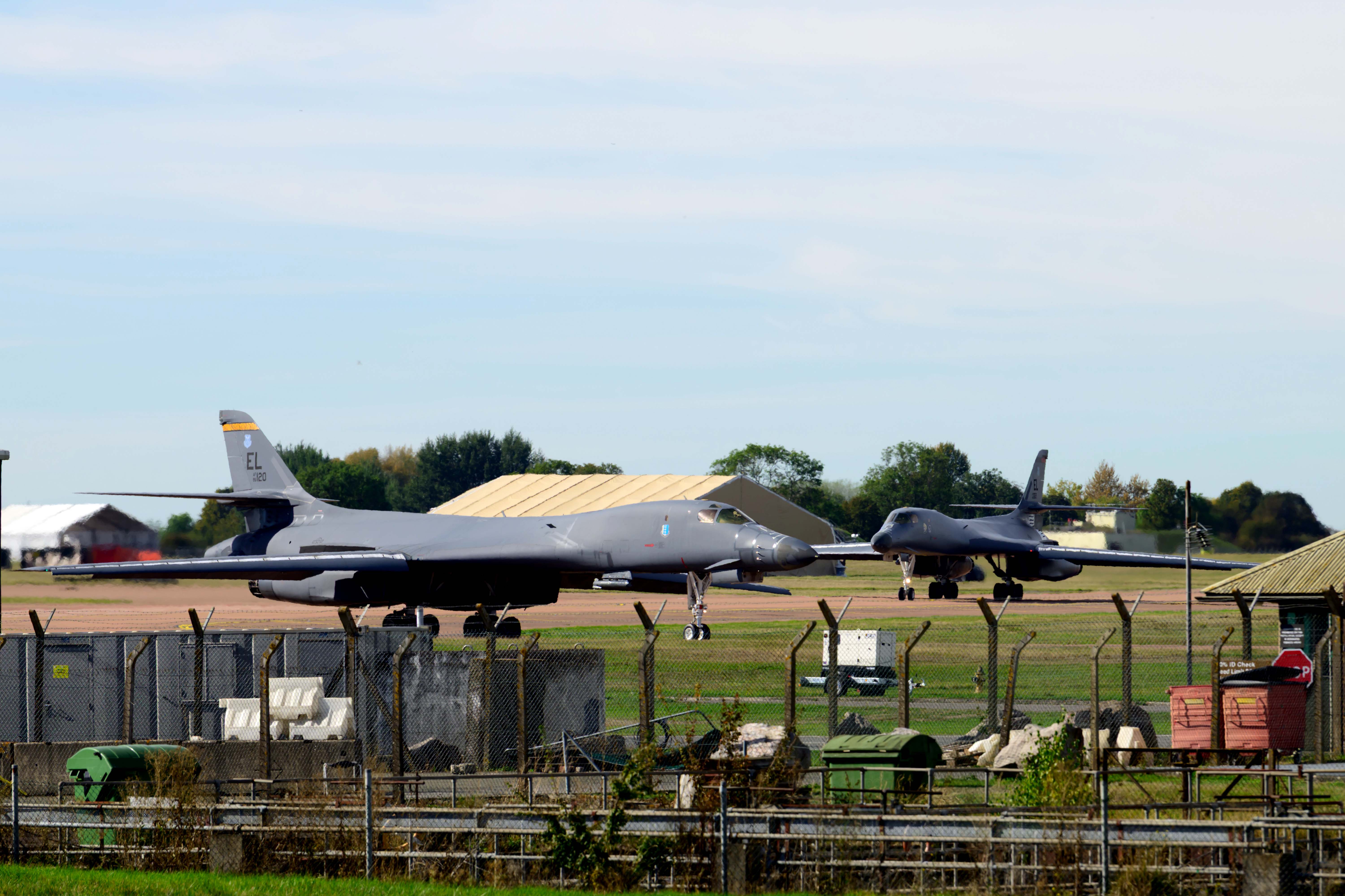
President Donald Trump said Monday afternoon that "threats" had prompted the U.S. to remove all of its B-1 Air Force bombers from the RAF Fairford base in southern England over the weekend. The move came a week after several men were arrested nearby in relation to a suspected terror plot, which the U.K. government believes may be linked to Iran.
When asked if there was a specific threat that led to the bombers being moved, Trump told reporters: “Yeah, I think we can say that. They didn’t fly out by accident. There were some threats, and rather than tempting the enemy… why should we leave them there? We moved them around a little bit, not very far.”
He added that Washington “actually knows the people that made the threat.” When asked if they are linked to Iran, Trump responded: “They would be linked to Iran.”
A U.S. Defense Department official had earlier told TIME that all the U.S. bombers had been ”re-deployed to their home stations in the United States,” but did not offer a specific reason behind the move, instead saying that U.S. bombers “routinely operate around the world to support global force readiness and operational requirements.” The official added that America’s bomber force remains “ready to deliver precision global strike capabilities… anywhere, anytime.” Hours before Trump's remarks, U.S. Secretary of State Marco Rubio dismissed the idea that the removal of U.S. bombers was directly connected to the foiled Fairford plot, insisting he has “confidence” in the security of U.S. bases.
A spokesperson for British Prime Minister Andy Burnham said the RAF Fairford base remains safe, but refused to offer any specific comment on the military operations of “foreign nations.” The British Ministry of Defense directed TIME to the U.S. Air Force when approached for comment.
The move comes after five men, all U.K. nationals, were arrested on suspicion of explosives and terrorism offenses on Sept. 27, following a suspected terror plot nearby RAF Fairford, an airbase used by the U.S. to strike Iran. Officers made the arrests after receiving a tip-off that three "suspicious vehicles" appeared to be heading toward the direction of the base. Amid ongoing investigations, British counterterrorism police arrested a dual British-Iranian national in central London on Oct. 1 on suspicion of terrorist acts in connection with the incident. All arrestees have been released on bail.
David Dunn, a professor of international politics at the University of Birmingham, says the U.S. withdrawal from Fairford is “historic, unprecedented, and an indication of the sense of vulnerability” surrounding U.S. military assets abroad.
“Fairford is normally the place during a crisis where America sends bombers to beef up America's military capability and its formal operating bases, whether that's for operations in Europe, like the Kosovo campaign, or for operations in the Gulf through 2003 onwards, or indeed for operations in Iran,” Dunn tells TIME. “This [removal] is an indication of concerns about the safety of those assets in their forward operating bases.”
Dunn adds “the haste” with which the operation took place over the weekend is also noteworthy, referencing reports that some of the aircraft had only been there for a relatively short period of time, having arrived recently as part of a rotation.
U.K. and U.S. officials suspect Iranian involvement in RAF Fairford plot
Both U.K. and U.S. officials have voiced suspicion of Iranian involvement in the suspected terror plot that has led to several arrests.
Burnham on Sept. 30 said the U.K. believes Iran was likely involved in the incident. “There are strong indications that Iran played a part in what happened at RAF Fairford, but of course it remains an ongoing, complex, and serious police investigation,” he said, adding that British forces were “working closely” with U.S. counterparts.
Iran has vehemently denied any involvement. In the immediate aftermath of the initial arrests, the Iranian embassy in London said it "categorically rejects and strongly condemns" any attempt to "link Iran to" the arrests made near RAF Fairford. After Burnham’s comments, Iran doubled down on its denial, with Foreign Minister Abbas Araghchi accusing the U.K. of “barking up the wrong tree.”
Trump previously said the five men arrested at the scene had been under “investigation” prior to the arrests and were looking to cause “big damage.” Asked whether Iran was involved in the suspect terror plot, he said, “it might be,” but did not offer further details.
Dunn says that although Iran “hasn't got the range to [directly] attack bases in the U.K.,” it does not necessarily remove the potential threat to U.S. assets stationed there. “Iran—by doing things via proxies, organized criminal gangs, or hiring people gangs through payments through the dark web—can still have a military effect and a deterrent effect on the operation of a base like Fairford,” he says.
Counter Terrorism Policing has said it is looking at all angles, citing possible foreign-state involvement as one line of inquiry. It has urged against conclusions being drawn in what is a high-profile and active investigation.
How RAF Fairford has supported U.S. military operations for decades
RAF Fairford is a NATO-designated standby deployment and a U.S. forward operating base for U.S. Global Strike Command, according to U.K. government records. The base, which opened in 1944, has been used extensively by U.S. military aircraft in previous conflicts, including "Operation Iraqi Freedom" in 2003.
The U.S. Air Force describes RAF Fairford as its “preferred” European “bomber forward operating location” and previously said it has used Fairford “nearly continuously” since the base was constructed.
Former British Prime Minister Keir Starmer initially refused to allow U.S. access to U.K. military bases in its offensive strikes against Iran—a move that earned him the wrath of Trump. Starmer changed his position in March, authorizing the U.S. to use bombers based at RAF Fairford to carry out strikes on Iranian missile sites used to attack ships in the Strait of Hormuz.
Iran’s Islamic Revolutionary Guard Corps (IRGC) warned the base could be a target on account of its use by the U.S. military, insisting it makes the U.K. a “participant in aggression” in the war.
Starmer had previously warned the British public of the general threat posed by Iran. On Feb. 28, in an address to the nation hours after the U.S. and Israel launched its initial strikes against Iran, he said: “Even in the United Kingdom, the Iranian regime poses a direct threat to dissidents and the Jewish community. Over the last year alone, they have backed more than 20 potentially lethal attacks on U.K. soil.”